As hard-partying culture steals youth from the church, one pastor seeks to bring them back.
On a Sunday night in March at Club Touch On in Kitale, a town in Trans-Nzoia county, Kenya, hundreds of young people dance to loud Afropop music under dim disco lights. Some take swigs from bottles of liquor or drags from their cigarettes. Groups of friends sit around tables laughing and drinking, while others are more interested in attracting the opposite sex.
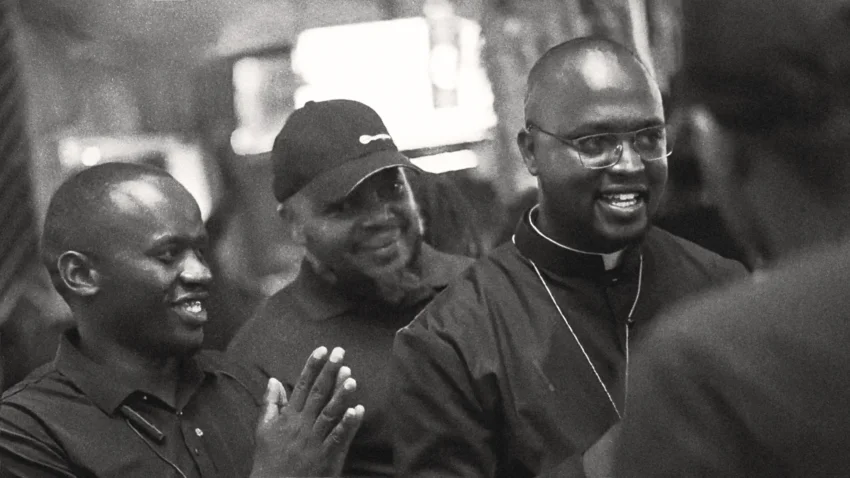
Then the DJ pauses the music and announces a special guest: padre Micheal Watenga. Two club bouncers escort Watenga, a young Anglican priest in a black robe and cross, into the room as partygoers burst into cheers, whistles, and applause. Holding a Bible, Watenga introduces himself and then begins a six-minute sermon: “I come to you because you are important before God.”
He urges the youth to trust in God, telling them Jesus loved sinners and the church has enough room to accommodate everyone. Then he prays aloud, his “Amen” interrupted by applause. As he leaves the club, youth stretch out their hands to touch his, asking for a blessing. Some follow him, requesting prayers to quit drinking or smoking, deal with relationship failures or rejection at home, or find employment. He speaks to a few and gives his phone number to those who ask.
“This is an important group that needs urgent rescue, yet the church has not done enough to fish them to Christ,” Watenga told CT.
While Watenga reserves Sunday mornings for his regular parish duties, he dedicates every Sunday night to club preaching. Every weekend, he visits a different club in a different town. Last September, Watenga founded Club Mission, a first of its kind ministry targeting young people who have abandoned church and turned to drug or alcohol abuse.
“I am proving that the church is not afraid of darkness,” he said. “I echo the voice through my presence that you’ve not been forgotten by Christ.”
According to Watenga, alcohol and drug addiction is the biggest problem affecting Kenyan youth. A recent report by Kenya’s Ministry of Health showed substance abuse—including use of illicit drugs, prescription medications, tobacco, cannabis, and khat (an evergreen shrub chewed for its stimulant-like effect)—affected nearly 10 percent of youths age 15–24. In February, the National Authority for the Campaign against Alcohol and Drug Abuse (NACADA) reported drug abuse in Kenyan universities has reached crisis levels.
Watenga, who grew up in a Christian family, watched many childhood friends and schoolmates drop out of their education due to excessive alcohol consumption. He said the community just looked on, without bothering to try to stop them.
Many of the youth he meets in clubs are looking for ways to escape from reality. According to Watenga, they feel stuck with their life and dreams on hold—unemployed or socially isolated—and their spirits overwhelmed by pressure from parents, church, and society to succeed. Many of the partiers from wealthy families want to shrug off their parents’ pressure to avoid interacting with people seen as lower class or to take up high-pressure university studies such as law.
Laura Mwangi, 24, a student in Nairobi, is from a religious family but said she sees hypocrisy at home and finds no reason to go to church: “[My] parents are always judging me. I find it hard to share my problems with them, so I go to [a] club where there is peace of mind.”
Sometimes church hurt fuels addiction. According to Baraka Moses, a university student in Eldoret, “The church is not a safe place for many of us. Many of us want to be loved and corrected with … love, not labeled or judged by how we behave or dress. The church shouts at us.”
Moses said he turned to drinking and clubbing after a bad experience at church. Older people criticized Moses, an aspiring musicians, for wearing dreadlocks. They asked him to shave them off or stop coming to church with such a “demonic” hairstyle. Meanwhile, Moses said, the pastor’s son dressed in suits and led opening prayers but often slept around with girls at the church.
In some of the clubs Watenga visits, youth with painful memories of church feel offended just seeing a priest there. At times clubs refuse to let him preach, thinking he just wants to collect money.
Watenga also faces pushback from local Christians who think his work is too dangerous or unlikely to produce converts.
“Some of the Christians see it sinful for me to go to clubs and preach, calling it unconventional,” Watenga said. “Some say I drink. Some of my fellow clergy see me as crossing the boundaries of my vocation and overstepping.”
Watenga said he is inspired by Jesus’ incarnational approach to evangelism—eating, drinking, and sharing tables with sinners and the socially rejected.
“Jesus went where people already were, not where they were expected to be,” Watenga said. “He said those who are well do not need a physician, but those who are sick.”
He avoids unsafe situations and attempts by revelers to give him money as an offering—something he doesn’t want—by keeping sermons to six minutes then slipping out almost immediately afterward.
Watenga said he’s helped more than 200 youth with drug and alcohol addictions begin recovery. He listens to young people talk about wanting to quit, reassures them that Jesus can bring healing, tells them they have worth in society, and then connects them with rehab centers, including one he’s partnered with in Nairobi—Foundation of Hope Addiction Treatment Centre—that will accept youth who can’t afford treatment.
Watenga often visits the youth he meets through his ministry at their homes or calls them on the phone to pray with them. He also counsels their parents about how to help their children.
David Barasa, 25, from Kitale, said he asked Watenga to pray for him to stop drinking. Watenga gave Barasa his phone number and prayed for him during their calls. Over time, Barasa said he felt the urge to drink slowly decrease: “I ended up stopping completely.”
Irine Cherotich, a university student from Eldoret, said she used to go clubbing with a group of girls who would often drink and smoke together until morning. Then Watenga’s sermon at a club in her town touched her. “I got saved that day and stopped going to clubs,” she said.
Watenga said he’s prayed for more than 400 youth from six different counties since he started the club in September. Still, he feels the limits of his ministry. Traveling across the country is difficult, and sometimes he works day and night to balance church duties with traveling to preach in clubs. Often, he struggles to find time to rest.
His phone is always buzzing with calls, texts, and WhatsApp notifications. Watenga said he had to set his WhatsApp to automatically delete messages every 12 hours to make room for new ones. On top of that, his spotty internet service and cheap phone’s two-hour battery life means he’s constantly scrambling to catch up.
“I have so many youths who are reaching out to me,” Watenga said. “But lack of modern equipment prevents me from keeping track of my new converts.”