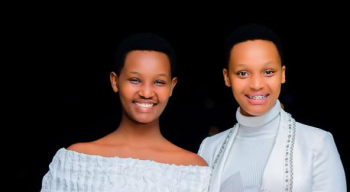
Have you ever wondered why the names Vestine and Dorcas are mentioned almost everywhere in Rwanda? They are different.
They are widely known and recognized by ordinary people, children, elders, people in rural areas, believers and non-believers alike.
Their songs are sung from cities to remote villages, often by people who don’t even use YouTube or music streaming platforms, yet they know both the songs and the voices behind them.
Over time, their influence has gone beyond Rwanda’s borders. Even people who do not understand Swahili can be heard singing parts of their songs.
Numbers, audience reactions, and public conversations all confirm one thing: Vestine and Dorcas are among the most well-known and influential female Gospel artists Rwanda has produced in recent years.
Their Unmatched Reach Through Music
It is rare to find an artist whose work consistently reaches millions of people. For Vestine and Dorcas, this has become almost normal.
Some of their songs have surpassed 30 million views, others 10 or 11 million, and even their least promoted releases often cross two million views shortly after release. For them, “a song that performed less” usually means one that was recently released and hasn’t yet had time to circulate fully.
Their music travels fast, on YouTube, on radio and television, in churches, bars, homes, and on the streets where people hum their melodies without even realizing how deeply rooted those songs have become in daily life.
Vestine, Rumors, and Public Attention
Vestine, in particular, has become one of the most talked-about Rwandan women online. A simple search of her name on YouTube reveals countless videos, some even created using artificial intelligence, making people believe they are real. Many of these videos have attracted hundreds of thousands of views.
Across social media and traditional media alike, Vestine has often been at the center of rumors, some believed instantly, others later exposed as false. This constant attention has made her one of the most discussed female public figures in Rwanda, illustrating both the power and the burden of fame.
One Name, Two Sisters
In Rwanda, “Vestine and Dorcas” has almost become a single phrase. People often assume that anyone named Vestine must also have a sister named Dorcas. Their identity as a duo is deeply embedded in the public mind.
This naturally raises questions: how did two girls from Northern Rwanda, once unknown even in their own community, rise to such national and international recognition? Is it purely divine grace, or is there something more behind their journey?
Roots: Faith, Family, and Early Talent
Vestine Ishimwe was born on February 2, 2004, in Musanze District, Northern Province of Rwanda. Two years later, on June 28, 2006, her younger sister Kamikazi Dorcas was born. They grew up in a Christian family led by their parents, Elizabeth Uzamukunda and Nizeyimana Mazimpaka, in a household where prayer, worship, and Christian values were part of everyday life.
From a very young age, both sisters showed an exceptional talent for singing. Between 2010 and 2017, while still under the age of ten, they joined children’s choirs in the ADEPR church, particularly Sunday School and later Goshen Choir. Their voices stood out so clearly that they were soon moved from children’s groups to sing alongside adults.
Listeners often said their voices carried something more than technical skill, there was emotion, message, and spiritual depth. Few realized then that this was the beginning of a historic journey in Rwanda’s gospel music.
From Church Choir to Professional Music
In 2018, still very young and without major resources, Vestine and Dorcas decided to pursue music independently. They began by recording gospel covers and sharing them online. Songs like Umutima, Hallelujah, Ndabihamya, and Ku Migezi revealed maturity beyond their age.
In 2019, with the help of Prince Layer (Maombe), they started managing their digital presence more strategically. On July 2, 2020, their YouTube channel officially launched, marking a turning point in their career.
That same year, journalist and media executive Murindahabi Irénée of M. Irene Entertainment (MIE) noticed their talent. After meeting and listening to them, he offered professional support, encouraging them to leave church choir structures and work as independent artists. They signed with MIE, gaining access to studios, professional production, media exposure, and structured management.
Their breakthrough song “Nahawe Ijambo” (2020) quickly became a national anthem of worship. It was followed by Papa and Adonai, solidifying their position among Rwanda’s leading gospel voices.
Challenges, Controversies, and Growth
In 2021, tensions arose when their parents expressed dissatisfaction with MIE’s management, especially regarding YouTube revenue and content ownership. The issue became widely discussed in the media. Despite the controversy, cooperation continued, and their music output remained strong.
On December 24, 2022, they held their first major concert at Camp Kigali to launch their album Nahawe Ijambo, reportedly generating around 15 million RWF in one night—a milestone for gospel music.
In 2023, they performed internationally for the first time in Burundi. In 2024, they expanded linguistically and musically by releasing Neema in Swahili, signaling their intention to reach a broader audience.
Marriage, Music, and Public Scrutiny
On January 15, 2025, Vestine legally married Idrissa Ouédraogo in Kigali. The event sparked intense public debate and speculation, especially given her young age and ongoing studies. Rumors spread rapidly, ranging from personal motives to industry manipulation.
Amid this attention, Vestine and Dorcas released “Yebo (Nitawale)” on March 5, 2025. The song became a historic success, reaching one million views in just five days and later surpassing 30 million views, redefining gospel music reach in Rwanda and beyond.
Their church wedding followed on July 5, 2025, at Intare Conference Arena. Shortly after, they released Emmanuel, which reached one million views in three days.
Personal Struggles and Continued Impact
After the wedding, Dorcas openly struggled with emotional separation from her sister, describing Vestine as a second mother.
Vestine herself later shared challenges in marriage, posting and then deleting an emotional message in November 2025 that sparked renewed public debate. She later removed wedding photos and reverted her social media name, fueling speculation, though no official statement was made.
Despite personal trials, their music continued. They toured Canada with the Yebo Concerts, released new songs like Usisite, and on November 30, 2025, won Worship Artists of the Year at the Diva Awards 2025.
Today, Vestine and Dorcas are firmly written into the history of Rwandan gospel music. Their story is not just about fame, numbers, or controversy, it is about talent nurtured in faith, resilience through public pressure, and growth through both success and hardship.

Vestine and Dorcas together with their manager, Irénée Murindahabi (Vestine on the right, Dorcas on the left).


Vestine

Dorcas


Their journey proves that when purpose, timing, belief, and perseverance come together, music can transcend borders and touch millions