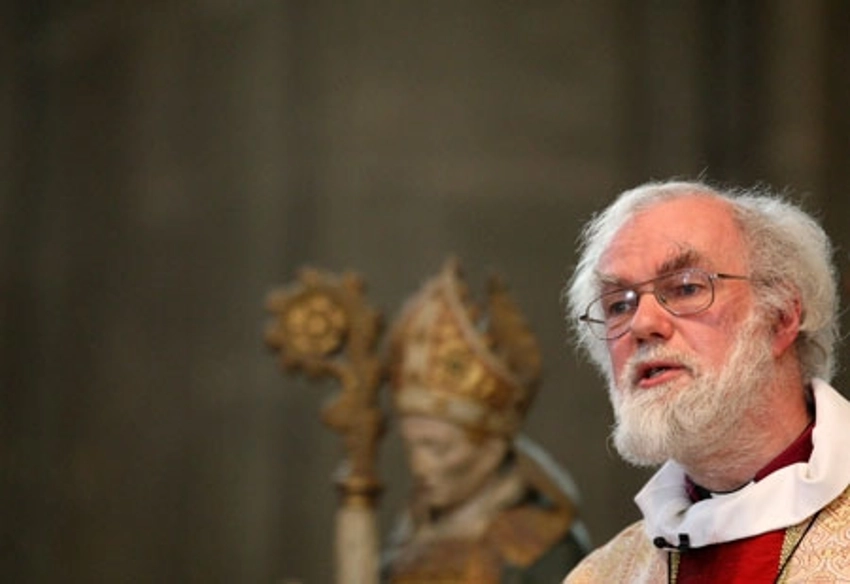
Rowan Williams, who served as archbishop of Canterbury from 2002 to 2012, questioned whether the Anglican Communion would continue to exist during a recent interview. "I don’t know whether the [Anglican] Communion will survive," Williams told Clerical Whispers in an interview published earlier this week.
Williams, whose book Solidarity: The Work of Recognition is scheduled to be published next week, said he would not attend the installation service of Archbishop Sarah Mullally, who will be formally installed as the 106th archbishop of Canterbury on March 25 at Canterbury Cathedral after making the 87-mile trek there from London on foot.
"You don’t want to be Marley’s ghost," Williams said of why he was foregoing attendance at his successor’s installation. The installation follows her formal election service last month at St. Paul’s Cathedral in London, during which the Rev. Paul Williamson was ejected from the service for shouting his objection to her confirmation.
Williams, who said the job of archbishop is "no walk in the park" and that there were many times he questioned whether serving in the role was "worthwhile," warned that Mullally would likely have to struggle with the same contentious issues he did during his tenure, singling out women’s ordination and "the same-sex question" as key flashpoints.
While he noted that "some of the bitterness has gone out of" the women’s ordination controversy, at least in England, Williams acknowledged that issues of gender and sexuality were effectively splitting the Anglican Communion globally. Mullally has expressed views supporting both women’s ordination and same-sex blessings.
Last month, the Church of England’s General Synod voted to end plans for stand-alone blessing ceremonies for same-sex couples in churches after extended debate.
Williams went on to suggest that the fractious battles taking place within Anglicanism are symptomatic of larger cultural fissures in society, which he attributed to "the pace of social change, the environmental crisis, a sense of a loss of control on lots of people’s parts — of decisions being made elsewhere."
"And particularly that sense of powerlessness — ’I do not know where the levers are that will give me some control.’"
When it was first announced last October, Mullally’s appointment prompted outrage from the Global Anglican Futures Conference (GAFCON), a global movement of conservative Anglicans, whose leaders responded by repudiating her office’s historical spiritual authority.
The Most Rev. Laurent Mbanda, chairman of the GAFCON Primates Council, said at the time that the Church of England had "chosen a leader who will further divide an already split Communion."
Mbanda asserted that due to "the failure of successive Archbishops of Canterbury to guard the faith, the office can no longer function as a credible leader of Anglicans, let alone a focus of unity."
"As we made clear in our Kigali Commitment of 2023, we can ’no longer recognize the Archbishop of Canterbury as an Instrument of Communion’ or the ’first among equals’ of global Primates," he added.
GAFCON launched in 2008 in Jerusalem, and the first official gathering of the Global Anglican Communion was held last week in Abuja, Nigeria. Despite initial plans to the contrary, the organization stopped short of electing someone to formally rival the archbishop of Canterbury.
Jon Brown - The Christian Post